The first twelve seconds
Wright Flyer 1903 Flyer
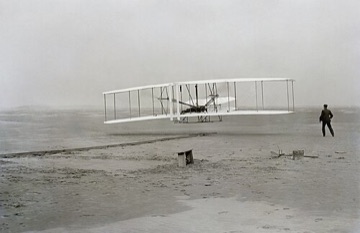
Twelve seconds, thirty-seven metres
The story
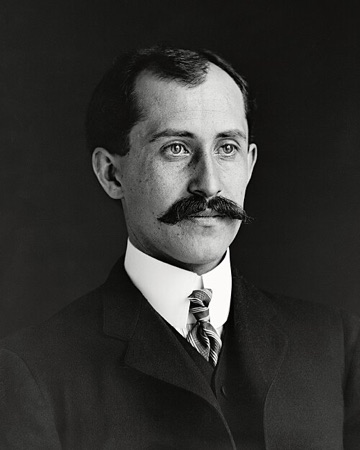
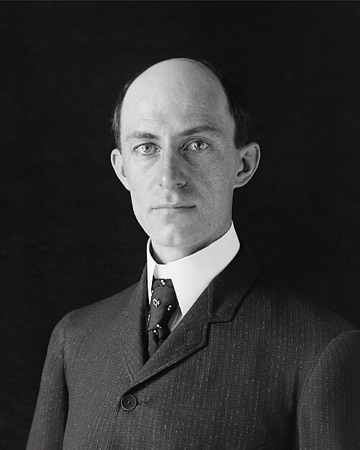
flew first, into a headwind of about 40 km/h, for 12 seconds and 36.6 m. took the fourth flight of the day to 59 seconds and 259.7 m. What made it work was control: the pilot lay in a hip cradle, and shifting it to roll the aircraft. later replaced the twist, but every aircraft since has rolled by changing the lift on one wing against the other.
The brothers built bicycles in Dayton, Ohio, and taught themselves to fly over four years of gliders. When the published tables of wing lift turned out to be wrong, they built a wind tunnel in 1901 and tested about 200 wing shapes in it. No engine maker could supply one light enough, so their mechanic, , built the 12 hp engine in six weeks, and they carved the two propellers themselves, treating each one as a wing that turns.
After the fourth flight a gust caught the parked Flyer and rolled it over, and it never flew again. By 1908 Orville was flying for more than an hour at a time, and in 1909 the US Army bought its first aeroplane from the brothers. A dispute with the kept the 1903 Flyer in London's Science Museum from 1928 to 1948; it has hung in Washington since.
How it works
Loading the 3D model…
Specifications
- Top speed
- 48 km/h
- Wingspan
- 12.3 m
- Max weight
- 341 kg
- Ceiling
- 3 m
- Range
- 260 m
- In 12 seconds
- 160 m
- Power
- 12 hp four-cylinder engine
Where it flew
Kill Devil Hills, near , North Carolina
Kill Devil Hills, North Carolina. The ground is washed back to the bare sand of 1903. The dunes have since been grassed over and the town has grown around the memorial. The simulator starts here, over today's ground and imagery of the place.
Fly it yourself
Take the Wright Flyer up in 3D, with its real weight, wing area and power.
Fly longer than Orville's 12 seconds. You have the same 40 km/h headwind he had.
On displayNational Air and Space Museum, Washington, D.C.